Parents & Families
We're honored that your family is considering Westminster College. Whether you've been through the college process before or your student is the first in your family to go — you belong here, and so do your questions. Parents and family members are an essential part of this journey. Our admissions team helps families with every step — applying, visiting campus, understanding financial aid, and figuring out what college will really cost. There's no question we haven't heard, and none too small to ask.
minimum merit scholarship, guaranteed for every accepted student
for qualified Pennsylvania families (the Westminster Advantage)
of 2025 graduates employed or in graduate school*
student-to-faculty ratio
From Our Admissions Team
College admissions has changed a lot since you were in high school — and if you never went through it yourself, the process can look more complicated than it is. So let's clear something up right away: applying to Westminster is free and simple. We need two things to make a decision — the application and a high school transcript. That's it. Test scores are optional. Essays and recommendation letters can help us get to know your student, but they're not required. No fee, no hoops, no tricks.
And you won't be navigating this with a website — you'll have a person. Every family is assigned an admissions counselor based on where you live, so the same person answers your calls from first question to move-in day. Is your student an athlete? About half of our students are, and we have a dedicated counselor just for studentathletes who works hand-in-hand with our coaches.
Meet the counselor for your area — or just call. One phone call (or quick email) usually saves a week of wondering.
Your Person at Westminster
Find your admissions counselor by state or county
Recruited athlete?
Or call the Office of Admissions:
724-946-7100
Small College, Outsized Results
Personal attention isn't just a nicer way to go to college. It's a better one - and the numbers show it. Because professors here know their students, they write the recommendation letters, open the lab doors, and make the calls the change trajectories. Westminster students don't just keep pace with national averages. They double them.
2X
Twice the national average acceptance rate to medical school.
2X
Twice the national average acceptance rate to law school.
2X
58% of students conduct research alongside professors — double the national average.
2X
100% of students graduate with real-world experience built into the curriculum: internships, research, clinicals, student teaching, field work, or a capstone.
1. Searching - Sophomore, Junior & Senior Year
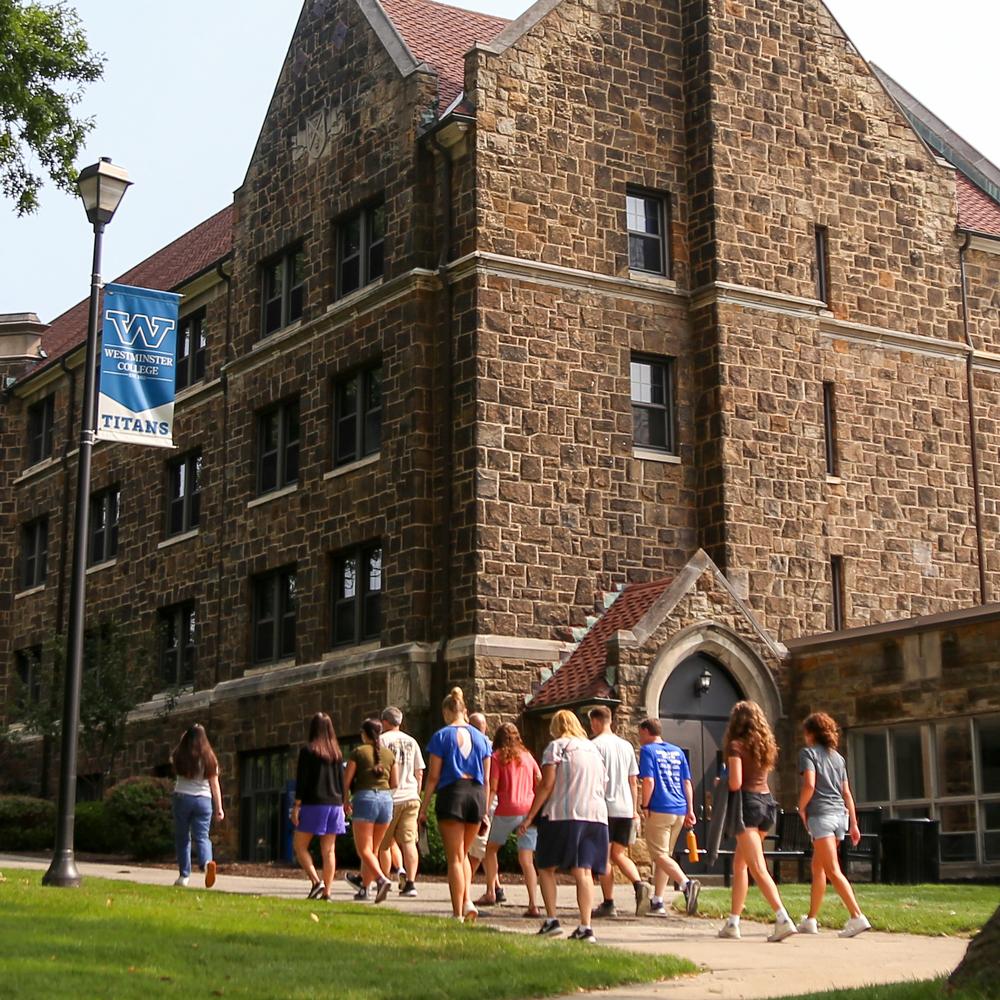
The best college for your student is the one where they'll be known, challenged, and supported — and the only way to feel that is to visit. At Westminster, visits are personal: a student-led tour, class sizes you can see for yourself, and time with an admissions counselor who can answer your questions on the spot. (And yes — the Visit Grant means coming to campus takes $1,000 off the first-year price.)
One tip from families who've been through it: don't visit just once. A campus feels different on a quiet summer afternoon than it does on a Tuesday when classes are changing.
The classic first visit.
Small-group tours leave at 10 AM and 2 PM every day — walk campus with a current student, see the residence halls and classrooms, and get your questions answered by an admissions counselor. Parents and siblings are always welcome.
Experience it in full swing.
Throughout the year, we open the whole campus to visiting families — Summer Information Session, Fall Open House, Discovery Day (your student sits in on real classes alongside current students), and Accepted Student Day (where admitted students connect with clubs, organizations, and future classmates).
Start from your couch.
Can't make the trip yet? Explore campus online anytime — then come see it in person when you're ready.
@westminsterpa — daily campus life
@westminsterpa_admissions — visits, events, and deadlines
Who actually teaches first-year classes — professors or teaching assistants?
What percentage of students come back for sophomore year?
How does the college help students find internships — and when does that start?
What does the average family actually pay after aid?
What happens when a student struggles — academically or personally?
2. Applying - Senior Year, Fall
Applying to Westminster is free, and we only need two things to make a decision: the application and a high school transcript. Test scores are optional; essays and recommendation letters are welcome but not required. Your student can use the Westminster Application (including our Express App) starting July 1, or the Common App starting August 1 — we treat them exactly the same.
Apply by November 1
"Westminster is my first choice, and I'm committing."
If admitted, your student agrees to enroll and deposits by January 15. Choose this only if you're sure — it's binding.
Apply by December 15
"I want my answer early, but I'm keeping my options open."
An early decision from us, with no obligation — your family still has until May 1 to decide.
Apply by March 1
"Senior fall got busy."
Applications are reviewed as they arrive. That's fine — but earlier is better for scholarships, aid, and housing.
July 1
August 1
October 1
Early Decision deadline
November 1
Early Application Grant
— apply by this date, earn $2,000November 1
Early Action deadline
December 15
Full-tuition scholarship consideration
— invited students, 3.75+ GPA, apply byJanuary 1
January 15
Rolling Admission
— apply byMarch 1
FAFSA Filing Grant
— apply by this date, earn $1,000April 1
PA State Grant deadline
Must file FAFSA by May 1 to be eligibleMay 1
May 1
Apply by November 1 and your student earns the $2,000 Early Application Grant — no extra form, no essay. And if your student has a 3.75+ GPA, applying by January 1 keeps them eligible for full tuition scholarship consideration if invited. At Westminster, being organized is worth real money.
The calendar is your job — students handle the application; you keep the dates. Put November 1 (Early Application Grant) and October 1 (FAFSA) on the family calendar now, and the rest follows.
3. Paying - The Question Every Family Asks First
Here's the secret most families learn too late: after scholarships and grants, a Westminster education often costs about the same out of pocket as a public state university — sometimes less. That's because the published "sticker price" isn't what families actually pay. Every accepted student receives at least $22,000 in merit scholarships — automatically, just for being admitted. Federal and state grants can stack on top. And for eligible Pennsylvania families earning $75,000 or less, the Westminster Advantage can bring tuition to $0.
So before you cross a private college off the list because of the price tag, run our numbers. Our Net Price Calculator takes a few minutes and shows your family's real cost — not the sticker.
No mystery, no waiting until the last minute. Your student's merit scholarship comes right in the acceptance letter — you'll know the biggest piece of the puzzle the day they're admitted. Then, for families who file the FAFSA, the complete financial aid award — grants and all — arrives by late February or early March. That's your true cost, in writing, well before the May 1 deposit deadline.
Your student's merit scholarship isn't a first year teaser — it's guaranteed at the same amount all four years. No renewal applications, no shrinking award sophomore year. Families can see their real cost from day one and plan all the way to graduation.
Students from beyond Pennsylvania receive a $2,000 Out-of-State Grant, renewable all four years — on top of their merit scholarship.
File the FAFSA with your student (it opens October 1 — Westminster's school code: 003392). The FAFSA is the free federal form that unlocks grants; filing it also earns your student Westminster's $1,000 FAFSA Filing Grant.
Pennsylvania residents: apply for the PA State Grant through PHEAA and submit the FAFSA by May 1 — it's free money, and it's required for the Westminster Advantage.
When offers arrive compare what each school will actually cost your family — the price minus scholarships and grants — not the sticker price. Bring us any offer, including other schools', and a counselor will walk through it with you line by line.
4. Deciding - Senior Year, Spring
When your student decides Westminster is home, the $200 enrollment deposit (non-refundable) is the key that turns everything else on: housing selection, course registration, orientation signup, and their Westminster email. Housing works first-come, first-served, so depositing early matters if your student has a roommate or hall preference. Deposits are due May 1 for general admission — Early Decision students deposit by January 15.
That's a good problem. Bring us the other letters — an admissions counselor will sit down with you (in person or by phone) and translate every line item so you're comparing apples to apples.
5. Sending Them Off - The Summer Before
Once your student is a Titan, our focus shifts to the transition — theirs and yours. It happens in two steps, and you're part of both:
One day in July, together.
Choose one of several one-day sessions held in July — and yes, parents attend too. This is the day your student's college life takes shape: they'll meet their faculty advisor, solidify their academic interests, and start planning their fall classes. You'll leave with your own questions answered — billing, housing, what happens next — from the people who run each office.
The week it becomes home.
The week before fall classes begin, new Titans move in and spend several days getting acclimated — finding their classrooms, meeting their professors and classmates, and settling into campus life — before a single assignment is due. By the first day of class, campus already feels familiar.
84% of our students live on campus, and the first weeks are when a small residential community proves its worth: professors notice empty seats, RAs knock on doors, and nobody gets lost in the crowd.
The hardest part of the first semester is often letting your student solve problems themselves. They'll stumble — that's part of it — and at a college this size, there's a safety net of people who know their name. When you're not sure whether to step in, call us first. We'll tell you honestly when to worry and when to wait.
What Parents Ask Us Most
We read every application holistically — but we're transparent about what carries the most weight. High school GPA has been studied extensively, and it remains the single strongest predictor of whether a student will complete a college degree. That's why it's the foundation of our review.
Holistic means what it sounds like: our Admissions staff reads the full application — transcript, personal statement, recommendations, and everything else submitted — before a decision is made. No part of it goes unread.
Test scores are optional. Choosing not to submit them will not hurt an applicant's chances of being admitted. We welcome scores from students who believe they strengthen their application, and we don't hold their absence against anyone. Letters of recommendation and a personal statement are also optional, and we're always glad to have them — they tell us things a transcript can't.
Westminster College is a test-optional* institution. Students are not required to submit test scores to be accepted to Westminster.
If you choose to submit test scores, you should be prepared to submit the test name, the test date, and the total/composite score and the primary score components for the following: The EBRW and Math Section scores for the SAT, and the English, Math, Reading and Science Reasoning scores for the ACT.
Westminster College accepts unofficial scores submitted by your high school (usually found on your official high school transcript). We also accept unofficial scores submitted by you, such as a picture or screenshot of your student page for College Board or ACT that shows your score.
* Please note that while Westminster College does not require ACT/SAT scores for admission, our partner institutions for the following advanced degree programs do require test scores for admission:
Only if they help your student. If a score reflects your student's ability better than the transcript does, encourage your student to send it. If it doesn't, leave it out and put energy into the parts of the application that show us who they are. Either path leads to the same review.
We encourage your student to tell us about it. We look at trends, not a single number. Life happens — an illness, a family change, a difficult year for reasons that have nothing to do with ability. When we see a dip in an otherwise upward record, we read it as what it usually is: one hard stretch, not a verdict on a student. A personal statement is the ideal place to give us the whole picture, and it's exactly the kind of context that helps us say yes.
A person — several, in fact. Applications are read by our Admissions staff, and every piece of a file gets attention. The transcript especially — we look at every grade in every course, not just the cumulative GPA.
Reading a transcript course by course is where the real picture emerges. We see which classes a student challenged themselves in, how they handled a subject that didn't come naturally, whether a rough semester was followed by a stronger one. A single number can't tell us any of that.
Every student is also assigned an Admissions Counselor, who serves as their point person throughout the process. The counselor isn't there to judge the application — they're there to help your student understand it. They can walk you through what we're looking for, explain where things stand, and answer questions at any stage. And if something in a file needs further explanation, there's a human on the other end who will ask the question rather than assume the answer.
No. Visiting doesn't factor into whether a student is admitted. We encourage visits because it's the best way to know whether Westminster is the right fit — but that's a decision that runs in your direction, not ours.
Not at all, and it's more common than families expect. Applying as an undecided student has no effect on admission, and Westminster's structure and curriculum is designed for students to explore before committing. Many students arrive certain about a major and change it anyway. Have your student select Exploratory for their intended program of study when completing the application and we will provide them with mentors that will help them select a major when the time is right.
No — applying to Westminster is free. Application fees add up quickly, and a student applying to several schools can spend real money before receiving a single decision. That quietly pushes families to narrow the list before they've had a chance to see what's out there. Students should be free to explore their options, and we'd rather earn a place on your list than charge for one.
Early Decision — apply by November 1. This is for students whose clear first choice is Westminster. It's binding: if admitted, your student agrees to attend Westminster and agrees to withdraw applications to all other schools. The payoff is an early answer on aid, housing, roommate, and class schedule, and a much calmer senior year. Enrollment deposit is due January 15.
Early Action — apply by December 15. You get an early answer without committing. It's nonbinding, you have until May 1 to decide, and you may be eligible for our $2,000 Early Application Grant if your student submits their application by November 1.
Rolling Admission — review begins December 1, with a March 1 deadline. We review as materials arrive and can often give a decision in days rather than weeks. Students who apply after March 1 are admitted based on remaining space in the first-year class. Deposit due May 1.
For a deep dive into admission plans, check out our Parent Blog.
Because three things fill up over the course of the year: seats in the class, scholarship consideration, and housing. Applying and depositing early puts your student in line first for residence hall and roommate assignments, which is the difference between choosing where you live and being placed. Early applicants also get priority consideration for merit scholarships, and Early Action applicants may qualify for the $2,000 Early Application Grant. After March 1, admission depends on space still being available.
The short version: nothing bad happens if you apply early, and several good things do.
Quickly. We know the waiting is the hardest part, and we don't stretch it out. Once your student's application is complete, review begins within days — not weeks or months. When a decision is ready, your student receives an email prompting them to check their application portal, and accepted students get a celebratory acceptance packet in the mail.
Private doesn't automatically mean more expensive. After scholarships and aid, many Westminster families pay about what they would at a state school — and some pay less.
A few things make that possible. Every accepted full-time undergraduate receives an academic scholarship from Westminster, before need-based aid enters the picture. Generations of alumni and friends of the College have funded additional scholarships specifically so that cost doesn't decide who gets to come here.
We also keep a close eye on what families pay at other institutions. We know where we land, and we're more competitively priced than most people assume before they run the numbers.
The only way to know your real number is to let us calculate it. Send us your FAFSA and we'll show you what a Westminster education actually costs your family — not the published price, but your price.
Three steps, in this order:
Not for our academic merit scholarships — every accepted full-time undergraduate is considered automatically as part of the admissions review. The FAFSA handles need-based aid. Outside scholarships and a handful of specialized awards may require separate applications, and your student's Admissions Counselor can point you toward those.
Talk to us before you rule Westminster out. Circumstances change, and sometimes an offer was built on information that's already out of date — a job loss, a medical situation, a change in household size. Our financial aid office can review your family's situation and tell you what's possible. The worst outcome of asking is that the answer stays the same.
File the FAFSA by May 1. That's the deadline for Pennsylvania residents to be considered for a PA State Grant through PHEAA, and it's firm.
The FAFSA alone doesn't finish the job. First-time applicants also need to complete the PA State Grant Form, and often a High School Form. PHEAA will email your student when those are ready — watch for it, because a missed form can cost your family the entire award. You can find the details and requirements at pheaa.org/grants/state-grant-program.
The PA State Grant is need-based gift aid. Your family never repays it. Families miss out on it every year simply because nobody told them it existed or the deadline slipped by in a busy spring — so put May 1 on the calendar now.
Not in the way it would at a public university. Westminster is a private college, so we charge the same tuition to every student regardless of where you live — there's no out-of-state penalty here. Our merit scholarships and need-based aid work the same way for your family as for a family who lives right down the street.
We also award a $2,000 Out-of-State Grant to students from outside Pennsylvania with completion of a FAFSA. Your student doesn't apply for it and you don't need to ask — we apply it automatically.
Live in Ohio or West Virginia? These are reciprocating states — you may be eligible for another $600 per academic year.
A $200 deposit holds your student's place in the class. It's due January 15 for Early Decision admits and May 1 for Early Action and Rolling admits. Depositing early is also what starts the housing process, so there's a real advantage to not waiting until the deadline. A deposit match grant is available through April 1.
More than you might think, and less than you might fear.
In practice, parents usually take the lead at a couple of key moments. You nudge your student to start looking. You suggest schools they haven't considered and help them narrow the list. You drive to the visits and debrief on the way home. You ask the questions that help your student figure out what they actually want — big or small, close or far, what they want their days to feel like. You keep the calendar and catch the deadlines before they slip past in the middle of a senior year that's already full. And you start the honest conversation about what your family can afford and what everyone expects. None of that is hovering. It's the support the whole search depends on.
Draw the line at the application itself. They need to be the ones to complete and submit the application. Let the essay sound like your student. Let the answers be theirs. Let them talk to their Admissions Counselor directly — students who own that part arrive on campus ready for the independence that comes next.
The financial side, though, is a family project. The FAFSA needs your information. Two sets of eyes comparing aid offers is better than one. Help your student understand the true cost of college in out-of-pocket expenses and in loans. Those conversations go further when your family starts them early rather than in April when the numbers land.
The balance most families settle into: your student drives, you navigate.
Every student is assigned an admissions counselor who works with families in your region, and they're the best first call for anything — application questions, aid questions, or a question you're not sure who to ask. You can also reach the Office of Admissions at 724-946-7100 or admissions@westminster.edu.
For the Road Ahead
Parents don't have to chase down information. Throughout the application cycle, we send families emails with the things that matter — important dates, deadlines, and what to do next — timed to where your student is in the process. The one thing we need from you: make sure we have your student's name and email and yours, so nothing gets missed.
Short, practical posts on the questions families ask most.
Fifteen minutes with an admissions counselor answers more than an hour of searching. Call, email, or visit — we're easy to reach and glad to help.